A tweet went viral this week. Stanford CS grad. 3.8 GPA. $180k in debt. Applied to 847 jobs since January. Got 3 phone screens. Zero offers.
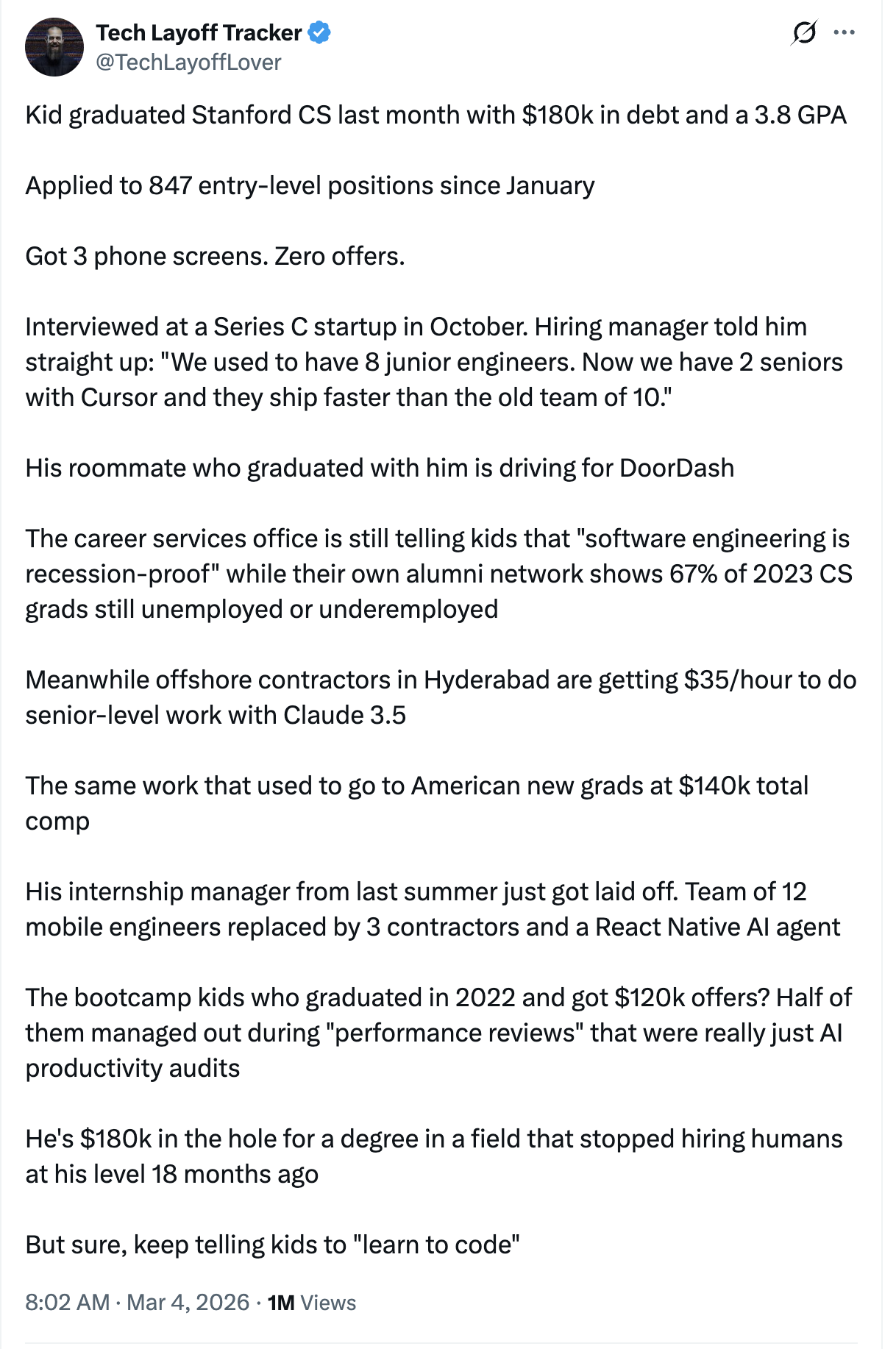
The hiring manager at a Series C startup told him straight up: "We used to have 8 junior engineers. Now we have 2 seniors with Cursor and they ship faster than the old team of 10."
The tweet ends with: "But sure, keep telling kids to learn to code."
I understand the frustration. But I think it's pointing at the wrong thing.
Is a CS degree worth it in 2025?
The short answer: yes. But not for the reason most people assume, and not in the way the job market used to reward it.
The degree isn't the problem
A CS degree — a real one, not a bootcamp certificate, not a semester of LeetCode — teaches you something that has nothing to do with writing syntax.
It teaches you to decompose problems. To model systems. To think about tradeoffs under constraints. To reason about things you've never seen before and build a path toward a solution.
That skill doesn't expire. It's not being replaced by Cursor or Claude 3.5.
What's being replaced is the job that skill used to fund entry into.
What actually changed
The junior engineering job was never really about the code. It was about getting paid to learn in a structured environment, surrounded by seniors who would review your work and shape your instincts.
AI compressed that on-ramp. Two senior engineers with good tooling now output what ten engineers used to. The companies didn't get rid of the thinking — they got rid of the execution headcount.
That's a real problem if your plan was: get degree → get job → write code for salary.
That plan is broken. Not the degree.
The edge is no longer execution
Here's the thing about AI that nobody says plainly enough: it will always execute better than you can. Given enough context, it writes cleaner code faster, with fewer bugs, at any hour.
If your value proposition is "I can implement this," you are competing with something that never sleeps, never asks for equity, and gets better every six months.
The edge that AI cannot replicate is this: identifying a problem that's actually worth solving, and caring enough about it to see it through.
That's not a technical skill. It's a human one. And a CS education — if you actually paid attention — sharpens exactly this. You spend four years learning to look at complex systems and find the leverage point.
The question is what you aim that at.
Stop trading time for money
The Stanford kid in that tweet has a terrible outcome. I'm not dismissing that. $180k in debt with zero offers is a genuine crisis.
But the path out isn't to wait for the job market to recover. The job market for junior engineers executing tasks is not coming back.
The path out is to stop thinking like an employee.
You have a CS degree. You can build software. You understand systems. You can learn anything technical faster than most people on earth. That's an enormous amount of leverage — but only if you point it at a problem you own, not a task someone else defined.
Build something. A small tool that solves your own problem. A SaaS that targets one niche. An API that something specific needs. Ship it before it's ready — that discipline is harder than writing the code and more valuable. Learn to talk about what you're building. Learn to find the people who need it and tell them it exists.
Those are the skills that matter now: identifying problems, building solutions, and selling them. Not the act of writing code. And what matters more than credentials is how you're perceived — that shift is already underway.
Marketing and sales aren't beneath you
The thing nobody teaches in CS programs: distribution is harder than building.
Every engineer I know who's building independently — including myself — hits the same wall. You can ship a product in a week. Getting your first 10 paying customers takes months, because you've never learned to find people with problems and explain why you solve them.
That gap is closeable. Marketing and sales are learnable skills, just like algorithms were. And once you have them alongside a technical foundation, you have something rare: you can find problems, build solutions, and get them in front of people. That's the full stack that matters.
A corporate job gives you salary. It takes your time, your leverage, and your upside.
What I'd tell the Stanford kid
Your degree didn't fail you. The plan of trading it for a junior engineering seat was the wrong plan for 2026.
You have four years of problem-solving training and the ability to build software. That's not nothing. That's a starting point most people would kill for.
Stop applying to 847 jobs. Start talking to people about problems they have. Build the smallest useful thing. Ship it before it's ready. Learn to write and talk about what you're building.
The corporate job was never the goal. It was a comfortable detour.
Now the detour is closed. That's not a tragedy. It's a forcing function.
Learn to code was never the advice. Learn to build things people need — and learn to find those people. That's the advice. It was always the advice.
Frequently asked questions
Is a CS degree worth it in 2025? Yes — but not for getting a junior engineering job. AI has compressed that on-ramp significantly. The value of a CS degree is the problem-solving and systems-thinking foundation it builds. That foundation matters more than ever if you point it at building your own products rather than trading time for a salary.
Is a computer science degree still worth it with AI? A CS degree teaches you to decompose problems, model systems, and reason under constraints. AI can't replace that judgment layer — it can only execute within it. The degree remains valuable; the traditional junior engineer career path it used to fund is what's changed.
What should CS graduates do if they can't find a job? Stop applying to hundreds of jobs. Start talking to people about real problems they have. Build the smallest useful thing. Ship it before it's ready. Learn to write and talk about what you're building. Distribution and sales are the skills that matter now, alongside your technical foundation.
Will AI replace junior software engineers? AI has replaced the execution component — writing boilerplate, implementing specified tasks. What it hasn't replaced: identifying what's worth building, caring about outcomes, and navigating real-world ambiguity. Engineers who think like founders will thrive. Those who compete with AI on execution speed will lose.
What skills matter for CS graduates in the AI era? Problem identification, product thinking, distribution, and communication. Technical execution is a commodity. Everything around it — transparency about what you're building, finding real users, iterating on feedback — is not.